
Table of Contents
- Introduction
- What Is an Insulated Garden Office?
- Is an Insulated Garden Office Worth It?
- Insulated Garden Office UK: Planning Permission
- Do You Need Building Regulations for a Garden Office?
- How Much Does an Insulated Garden Office Cost in the UK?
- What Size Garden Office Do You Need?
- How Much Electricity Does a Garden Office Use?
- How Much Does It Cost to Run a Garden Office?
- How Do You Get Electricity to a Garden Office?
- Can Solar Panels Power an Insulated Garden Office?
- How Should You Insulate a Garden Office?
- How Do You Heat an Insulated Garden Office?
- Can an Insulated Garden Office Overheat in Summer?
- How Do You Get Internet to a Garden Office?
- Is an Insulated Garden Office Worth It for Year-Round Use?
- FAQ: Insulated Garden Office
Introduction
An insulated garden office can turn an unused part of your garden into a comfortable workspace without extending your house. But if you plan to use it throughout the year, insulation is only one part of the equation.
You also need to consider planning permission, electricity, heating, ventilation, internet access and running costs.
This guide explains what to consider when building or buying an insulated garden office in the UK.

What Is an Insulated Garden Office?
An insulated garden office is a garden building designed for regular use, with insulation and other features that make it more comfortable than a basic shed or summerhouse.
A typical insulated garden office may include:
-
Insulated walls, roof and floor
-
Double-glazed windows
-
Insulated doors
-
Electrical sockets and lighting
-
Heating
-
Ventilation
-
Internet connectivity
Insulation slows down heat transfer. In winter, it helps reduce heat escaping from the room, while in summer it can slow the rate at which heat enters.
However, insulation does not generate heat or cool the room by itself. Windows, doors, ventilation, heating and the overall construction also affect comfort.
Is an Insulated Garden Office Worth It?
Whether an insulated garden office is worth the investment depends on how often you plan to use it.
If you only need a garden room during warm weather, a simpler structure may be sufficient. For regular home working, however, insulation becomes much more valuable.
A well-insulated garden office can:
-
Reduce heat loss in winter
-
Reduce heating demand
-
Help maintain a more stable temperature
-
Slow heat gain in summer
-
Make the room more suitable for year-round use
The best results come from treating the building as a complete system rather than focusing on insulation alone.
Insulated Garden Office UK: Planning Permission
Planning permission is one of the first things to check before building a garden office.
In England, many garden offices can fall under permitted development if they meet specific conditions. For example, an outbuilding generally needs to be single-storey, and if it is within 2 metres of the boundary, its maximum height is 2.5 metres. No more than half the land around the original house can be covered by additions or other buildings.
Other restrictions can apply depending on the building's height, position and design. Listed buildings, conservation areas and properties with restricted permitted development rights may also require additional checks.
Planning rules differ across England, Wales, Scotland and Northern Ireland, so make sure you check the rules that apply to your property.
Do You Need Building Regulations for a Garden Office?
Planning permission and building regulations are separate issues.
Depending on how your garden office is constructed and used, relevant building standards may apply. Electrical work also needs to meet the applicable safety requirements.
If you are installing a permanent electricity supply, it is generally better to have the work designed and carried out by a qualified electrician.
A permanent installation may involve:
-
Suitable outdoor-rated cable
-
Circuit protection
-
RCD protection
-
Properly installed sockets and switches
-
Safe cable routing and protection
An extension lead may be useful for temporary outdoor equipment, but it should not normally be treated as a permanent replacement for a properly installed electrical supply.
How Much Does an Insulated Garden Office Cost in the UK?
The total cost varies significantly depending on size, construction method, foundations, insulation, windows, electrical installation and interior finish.
Typical cost areas include:
| Cost area | What affects the price |
|---|---|
| Foundations | Ground conditions and foundation type |
| Building structure | Size and construction method |
| Insulation | Material and thickness |
| Windows and doors | Glazing and quality |
| Electricity | Cable length and installation |
| Heating | Heater type and installation |
| Internet | Wi-Fi, Ethernet or mobile broadband |
| Interior | Flooring, lighting and furniture |
A basic small insulated garden office can cost several thousand pounds, while a larger, fully finished garden room can cost considerably more.
When comparing prices, look beyond the advertised building cost. Foundations, electrical work, heating and interior finishing can add significantly to the final budget.
What Size Garden Office Do You Need?
The right size depends on how you intend to use the space.
Small: Suitable for a desk, chair, laptop and basic storage.
Medium: More suitable for a larger desk, monitor, storage and additional furniture.
Large: Better if you want to combine your workspace with storage, exercise equipment, a meeting area or another activity.
Before choosing a size, consider the available garden space, access, furniture and the position of windows and electrical points.
How Much Electricity Does a Garden Office Use?
Electricity consumption depends heavily on what you use inside the office.
| Device | Typical power |
|---|---|
| Laptop | 50–100W |
| Monitor | 30–50W |
| Wi-Fi router | 10–20W |
| LED lighting | 5–15W |
| Printer | 300–800W |
| Electric heater | 1,000–2,000W |
These are typical ranges rather than fixed values. Actual consumption varies between devices.
Heating is usually the biggest factor. A laptop and monitor may use relatively little electricity, while an electric heater can consume more than 1,000W when operating.
For example, a 1,500W heater running for eight hours would theoretically use:
1.5kW × 8 hours = 12kWh
A thermostat may cycle the heater on and off, so actual consumption can be lower.

How Much Does It Cost to Run a Garden Office?
Your running cost depends on your electricity tariff and how much power the office consumes.
From 1 October to 31 December 2026, Ofgem's average electricity unit rate for standard variable tariffs paid by Direct Debit is 26.32p/kWh across England, Scotland and Wales. Ofgem – Energy Price Cap
Using this rate, 12kWh would cost approximately:
12 × £0.2632 = £3.16
If the same amount of electricity were used on 20 working days, the theoretical cost would be around £63 per month.
This is only an example. Better insulation, thermostat-controlled heating and shorter heating periods can all reduce actual consumption.
How Do You Get Electricity to a Garden Office?
There are several ways to power a garden office:
| Option | Best suited to | Main advantage | Limitation |
|---|---|---|---|
| Mains electricity | Regular year-round use | Reliable and supports high loads | Installation required |
| Extension lead | Temporary use | Simple | Not ideal as permanent wiring |
| Portable power station | Backup or flexible use | No permanent connection required | Limited runtime |
| Solar + power station | Off-grid or backup use | Can recharge using solar | Solar output varies |
For a permanent home office, mains electricity is usually the most practical option, especially if you regularly use electric heating or other high-power equipment.
A portable power station is more useful as a backup or flexible power source.
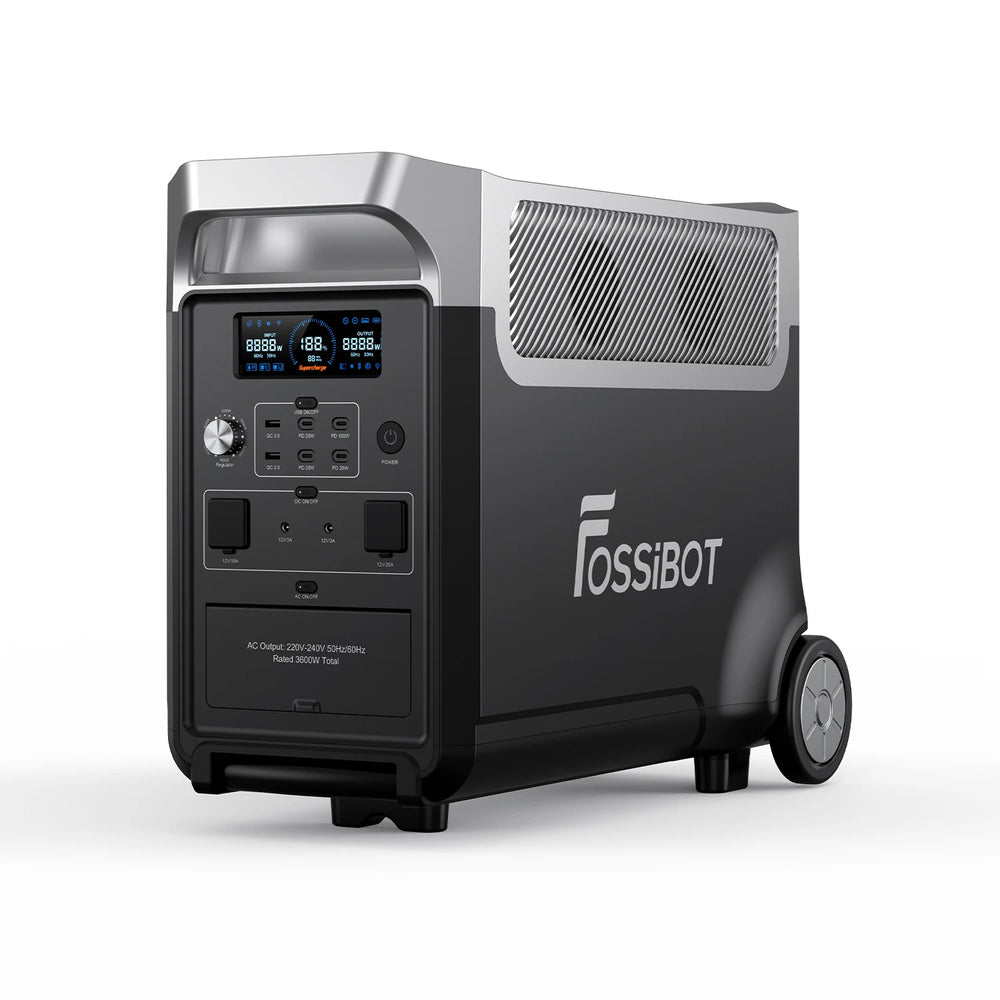
For example, FOSSiBOT's UK range includes the F1800 with 1,024Wh capacity and 1,800W output, the F2400 with 2,048Wh and 2,400W output, and the F3600 Pro with 3,840Wh and 3,600W output.
These can be useful for keeping laptops, monitors, routers and lighting running during a power cut. Larger-capacity models can provide longer backup times or support more equipment.
A simple runtime estimate is:
Runtime ≈ Battery Capacity (Wh) × 0.85 ÷ Device Power (W)
For example, a 1,024Wh power station powering a 120W load could theoretically provide around 7.3 hours after allowing for typical conversion losses.
However, high-power appliances such as heaters can drain a battery quickly. For long periods of heating, mains electricity is generally more practical.
Can Solar Panels Power an Insulated Garden Office?
Solar can be combined with a portable power station to provide an alternative or backup source of electricity.
A typical setup is:
Solar panels → Portable power station → Garden office equipment
Solar generation varies depending on weather, season, shading, panel orientation, daylight hours and the solar input capacity of the power station.
This means solar can be useful for reducing reliance on mains electricity or providing backup power, but output will not be consistent every day.
For year-round reliability, combining mains electricity with solar and battery backup can provide more flexibility.

How Should You Insulate a Garden Office?
Insulation should cover the main areas of the building:
Walls
PIR boards can provide high thermal performance for their thickness, while mineral wool can offer both thermal and acoustic benefits.
Roof
Good roof insulation helps reduce heat loss in winter and slows heat gain during hot weather.
Floor
Floor insulation can improve comfort and reduce heat transfer to the ground.
Windows and doors
Double glazing and properly sealed doors help reduce heat transfer and draughts. Large windows can also increase solar heat gain in summer, so their position should be considered carefully.
Ventilation
A well-insulated room still needs adequate ventilation. Working inside for several hours can increase humidity and carbon dioxide levels, potentially causing condensation and poor indoor air quality.
Good insulation therefore needs to be balanced with ventilation and appropriate heating.
How Do You Heat an Insulated Garden Office?
Common heating options include:
-
Electric panel heaters
-
Infrared heaters
-
Air-conditioning systems with heating functions
-
Other suitable fixed or portable heating systems
The best option depends on the size of the room, insulation and how often you use the office.
When choosing a heater, consider both its power rating and operating time. A 2,000W heater can provide substantial heat, but continuous use can significantly increase electricity consumption.
For a regularly used office, good insulation combined with thermostat-controlled heating can help reduce unnecessary energy use.
A portable power station can provide backup power for office electronics, but using one for all-day electric heating is generally less practical because heaters consume considerably more power.
Can an Insulated Garden Office Overheat in Summer?
Yes. Insulation slows heat transfer but does not prevent overheating.
Large windows exposed to direct sunlight can create significant solar heat gain. To improve summer comfort, consider:
-
External shading
-
Blinds or curtains
-
Good ventilation
-
Opening windows when conditions allow
-
Appropriate window placement
-
Solar-control glazing where suitable
The goal is to balance winter heat retention with summer heat management.
How Do You Get Internet to a Garden Office?
A reliable internet connection is essential for many home workers.
Wi-Fi: A mesh system can extend your existing home network.
Ethernet: A wired connection can provide a stable connection between the house and office.
4G or 5G: Mobile broadband can be useful when running a network cable is difficult or when you want an independent connection.
A portable power station can also provide backup power for a router or mobile broadband device during a power cut, provided its capacity and output are suitable.
Is an Insulated Garden Office Worth It for Year-Round Use?
For someone who works from home regularly, an insulated garden office can be a worthwhile investment.
The main benefit is having a dedicated workspace that remains more comfortable across different seasons.
Before making a decision, consider the complete cost of:
-
The garden office structure
-
Foundations
-
Insulation
-
Windows and doors
-
Electrical installation
-
Heating
-
Internet
-
Interior finishing
-
Furniture
If you only need a summer workspace, you may not need the same level of insulation, heating or electrical infrastructure.
For year-round home working, however, investing in good insulation, ventilation, heating and reliable electricity can make the space much more practical.
FAQ: Insulated Garden Office
What is an insulated garden office?
An insulated garden office is a garden building designed for regular use, with insulation in areas such as the walls, roof and floor, usually combined with suitable windows, doors, ventilation, heating and electricity.
Does an insulated garden office need planning permission?
Not necessarily. In England, some garden offices can fall under permitted development if they meet the relevant conditions. Planning rules vary depending on the property and location.
How high can a garden office be?
In England, an outbuilding within 2 metres of the property boundary generally has a maximum overall height of 2.5 metres under permitted development rules. Other restrictions can apply depending on the building and its location.
How much does an insulated garden office cost?
The total cost depends on the size, construction, insulation, foundations, windows, electrical installation, heating and interior finish. A basic small office can cost several thousand pounds, while a larger finished garden room can cost considerably more.
How much electricity does a garden office use?
A basic workstation with a laptop, monitor, router and LED lighting may use relatively little electricity. Heating usually accounts for a much larger share of energy consumption.
Can a portable power station run a garden office?
Yes, for suitable loads. A portable power station can provide backup electricity for laptops, monitors, lighting and routers. High-power appliances such as electric heaters can drain the battery much faster.
Can solar panels power a garden office?
Solar panels can help power or recharge a garden office system, especially when combined with a portable power station. However, solar generation varies with weather, season, shading and daylight hours, so solar alone may not provide consistent power throughout the year.


