
Table of Contents
- Introduction
- What Does 1024Wh Mean?
- Wh vs. W – The Crucial Difference
- How to Calculate Runtime for Any Device
- Why Real‑World Runtime Differs from the Calculation
- Runtime Estimates for Common Loads (50W – 1500W)
- F1200 vs. F1800 – Same Capacity, Different Output
- Does Higher Wattage Mean Longer Battery Life?
- How to Get More Runtime from Your 1024Wh Station
- Real‑World Scenarios: Camping, CPAP, RV, Home Backup
- FAQ
- Conclusion
Introduction
If you’re considering a portable power station with a 1024Wh battery, the one question that probably matters most is: how long will it actually last? Whether you’re planning a weekend camping trip, preparing for a home emergency, or need overnight power for a CPAP machine, the answer depends entirely on what you plug into it.
A 1024Wh power station can run low‑draw devices for many hours, while high‑power appliances (like a kettle or space heater) will drain the same battery much faster. That’s because battery capacity and output power are two different specifications – and understanding both is the key to choosing the right unit for your needs.
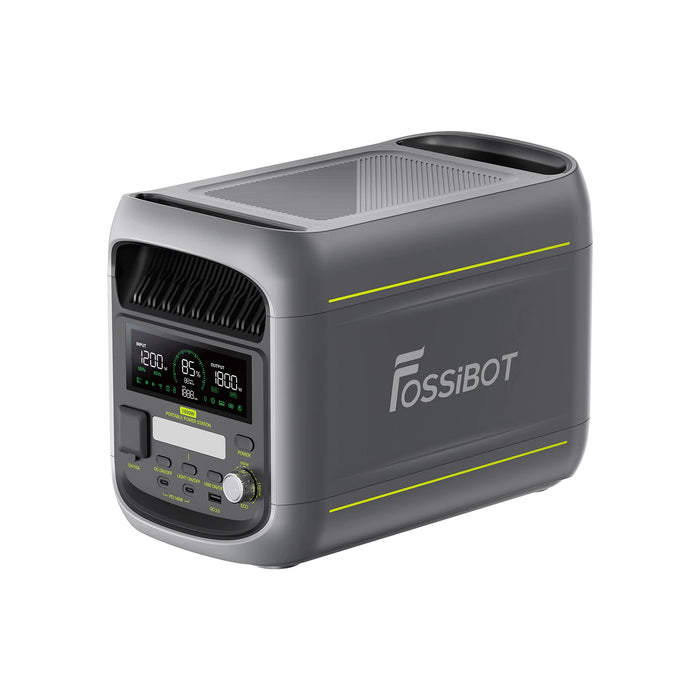
In this guide, we’ll explain what 1024Wh really means, show you a simple formula to estimate runtime, and compare two FOSSiBOT power stations that share the same 1024Wh capacity but offer different output ratings: the F1200 and the F1800.
By the end, you’ll be able to estimate how long a 1024Wh power station can power your specific devices – and you’ll know when a higher wattage output actually matters.

What Does 1024Wh Mean?
Wh stands for watt‑hours, a unit of energy capacity. In theory, a 1024Wh power station can deliver:
- 1024W for 1 hour
- 512W for 2 hours
- 256W for 4 hours
- 128W for 8 hours
- 64W for 16 hours
These are idealised figures – they don’t account for energy losses during real‑world use (inverter inefficiency, heat, standby consumption). But the key takeaway is this: 1024Wh tells you how much energy is stored in the battery, not how much power a device draws at any given moment.
Wh vs. W – The Crucial Difference
This is one of the most important concepts when comparing portable power stations.
- Watts (W) measure power – the instantaneous electricity a device needs to run.
- Watt‑hours (Wh) measure energy – the total amount of electricity the battery can store over time.
Think of it this way:
W tells you what you can power; Wh tells you how long you can power it.
For example, a 100W laptop charger needs 100W while it’s running. A 1024Wh battery has far more stored energy than a 100Wh battery, so it can run that laptop for many more hours.
This is why a power station with a higher output wattage does not automatically last longer – you must look at both capacity (Wh) and output (W) to understand performance.

How to Calculate Runtime for Any Device
The basic formula is straightforward:
Estimated Runtime (hours) = Battery Capacity (Wh) × Efficiency ÷ Device Power (W)
For example, if you’re powering a 100W device with a 1024Wh station, assuming an 85% efficiency factor (typical for inverter losses):
1024Wh × 0.85 ÷ 100W ≈ 8.7 hours
Without efficiency losses, the theoretical runtime would be 10.24 hours – but in practice, you’ll get closer to 8–9 hours depending on the load and conditions.
Pro tip: For the most accurate estimate, check the actual average power draw of your device (often shown on a display or in the specs) rather than its maximum rated wattage.
Why Real‑World Runtime Differs from the Calculation
Your device may not consume a constant amount of power throughout its operation. A laptop, for instance, draws more when gaming or rendering video, and much less when idle. Many appliances cycle on and off automatically (like refrigerators or fans), so their average draw is lower than their peak rating.
Other factors that affect actual runtime:
- Inverter conversion losses (typically 10–15%)
- Device power fluctuations
- Standby consumption of the power station itself
- Ambient temperature (extreme heat or cold can reduce battery efficiency)
- Battery age and condition
- Output port used (AC vs. DC – DC is usually more efficient)
That’s why all runtime estimates should be treated as planning guides, not guarantees.
Runtime Estimates for Common Loads (50W – 1500W)
Here’s a quick reference table using the same 85% efficiency factor for a 1024Wh battery:
|
Average Load |
Estimated Runtime (approx.) |
|
50W |
~17.4 hours |
|
100W |
~8.7 hours |
|
200W |
~4.4 hours |
|
300W |
~2.9 hours |
|
500W |
~1.7 hours |
|
1000W |
~0.9 hours (52 min) |
|
1500W |
~0.6 hours (35 min) |
These figures are estimates – your actual runtime may vary. But they give you a clear picture: doubling your load roughly halves your runtime.
F1200 vs. F1800 – Same Capacity, Different Output
FOSSiBOT offers two power stations with an identical 1024Wh battery capacity but different output capabilities:
|
Specification |
FOSSiBOT F1200 |
FOSSiBOT F1800 |
|
Battery Capacity |
1024Wh |
1024Wh |
|
Continuous Output |
1200W |
1800W |
|
Peak Output |
2400W |
3600W |
So, does the F1800 last longer than the F1200? Not necessarily.
Because both have the same 1024Wh capacity, powering the same device at the same average load will yield a very similar theoretical runtime (assuming comparable efficiency).
The real difference is what they can run.
The F1200 can handle loads up to 1200W continuously; the F1800 goes up to 1800W. That extra headroom means the F1800 can power larger appliances – like a 1500W space heater or high‑powered kitchen gadget – that the F1200 simply cannot.

Does Higher Wattage Mean Longer Battery Life?
This is a common misconception.
A 1800W power station does not automatically last longer than a 1200W one if both have the same 1024Wh battery. When you connect a 500W device, both will run for about 1.7 hours (estimated). The higher output rating only becomes relevant when your device demands more power than the lower‑rated unit can supply.
- A 500W load is well within both ratings.
- A 1000W load is also within both.
- A 1500W load exceeds the F1200’s 1200W continuous output, but is fine for the F1800.
In short:
- Wh = runtime
- W = compatibility with high‑power devices
Choose based on what you need to power, not just on wattage numbers.
How to Get More Runtime from Your 1024Wh Station
Even with the same battery, your actual runtime can vary significantly. Here are four practical tips to extend it:
- Reduce unnecessary load – Turn off devices you’re not using, and unplug chargers that aren’t actively charging. Every watt counts.
- Use ECO mode – Many stations, including the FOSSiBOT F1800, feature an ECO mode that reduces idle consumption and manages power more efficiently. Enable it when possible.
- Avoid running multiple high‑power devices simultaneously – If you need to run an 800W appliance and a 600W one, your total load is 1400W – that will drain the battery quickly and may exceed the output limit of some stations. Stagger usage if you can.
- Check your device’s actual power draw – The number printed on the label is often the maximum rating. Use a plug‑in power meter or check the device’s real‑time display to get an average figure, then recalculate your expected runtime.
Real‑World Scenarios: Camping, CPAP, RV, Home Backup
To make the numbers more tangible, here are some common use cases for a 1024Wh power station:
- Camping / Weekend trips – Running LED lights (10W), a portable fridge (40‑60W average), and charging phones/laptops. Total load ~60‑80W → you can easily get 12‑15 hours of use, often lasting a full weekend with solar recharging.
- CPAP machine overnight – Most CPAP devices draw between 30‑60W (without heated humidifier). At 50W average, a 1024Wh station gives you ~17 hours – more than a full night’s sleep, with peace of mind.
- RV / Van life – Powering a small TV (50W), a fan (30W), and charging devices. With moderate use, you can stretch runtime beyond 10 hours.
- Home emergency backup – Keeping a router, modem, a few LED bulbs, and a small fridge running. If your total load is around 200W, you’ll get about 4.4 hours – enough to weather short outages.
These examples show that a 1024Wh station is extremely versatile – it shines best with low‑ to medium‑power devices over extended periods.
FAQ
Is 1024Wh enough for a portable power station?
For many everyday uses, yes. It offers a great balance between capacity and portability. How long it lasts depends entirely on your total load.
How long will a 1024Wh power station run a 100W device?
With 85% efficiency: 1024 × 0.85 ÷ 100 ≈ 8.7 hours. Actual runtime may be higher or lower.
How long will it run a 500W device?
About 1.7 hours using the same formula. This is an estimate – check your device’s actual draw for better accuracy.
Can a 1024Wh power station power a refrigerator?
Yes, if the fridge’s running wattage is under the station’s continuous output (e.g., 60‑150W for many mini‑fridges). However, start‑up surges may be higher – check the peak rating. Runtime will depend on the fridge’s duty cycle; you might get 6‑10 hours of typical use.
Is an 1800W power station better than a 1200W one?
It’s better only if you need to run devices above 1200W. For lower‑power devices, the runtime is essentially the same because both have the same battery capacity.
Does higher output wattage mean longer battery life?
No – output wattage (W) and battery capacity (Wh) measure different things. Higher W doesn’t extend runtime; it just enables you to run heavier loads.
Can a 1024Wh power station run a 1500W appliance?
It depends on the station’s continuous output. The F1200 cannot (1200W limit), but the F1800 can (1800W rating). Always check surge requirements too.
Conclusion
So, how long will a 1024Wh power station last?
The answer is driven primarily by your load. Use the simple rule:
Runtime ≈ Capacity (Wh) × Efficiency ÷ Average Load (W)
For a 1024Wh station, low‑power devices can run all day, while high‑power appliances may drain it in under an hour. That’s why you should always consider both capacity (Wh) and output (W) when choosing a power station.
When comparing the FOSSiBOT F1200 and F1800, remember: both give you the same 1024Wh of stored energy – but the F1800 gives you extra headroom for larger appliances.
Wh tells you how long. W tells you what you can power.
Understanding both makes it much easier to pick the right station and realistically estimate runtime for your specific needs.


