
- What Is an Electric Hook‑Up (EHU)?
- Why Camp Without an EHU?
- What Do You Actually Need Electricity For?
- How Much Power Do You Need Without an EHU?
- How to Get Electricity When Camping Without EHU
- Power Options at a Glance
- How Long Can You Camp Without an EHU?
- How to Make Your Power Last Longer
- What Is the Best Power Setup for EHU‑Free Camping?
- Camping Without EHU: A Simple Approach
- FAQ
- Conclusion
Introduction
Camping without an electric hook‑up (EHU) gives you more freedom when choosing a pitch and can make it easier to enjoy a genuinely off‑grid trip. But going without mains electricity does not mean giving up every modern convenience.
Your phone may still be needed for navigation, your camera may need charging, and you might want to use camping lights, a laptop, fan or portable cooler. The key is to understand how much electricity you actually need and choose a practical way to store or generate it.
This guide explains how EHU works, what you need power for when camping, and how to stay powered when your pitch has no electric hook‑up.

What Is an Electric Hook‑Up (EHU)?
An electric hook‑up is a mains electricity connection provided by a campsite. It allows your tent, caravan or motorhome to connect to the site's electrical supply instead of relying entirely on batteries or other off‑grid power sources.
UK campsites commonly offer 16A hook‑ups, although some sites may have lower limits such as 10A or 6A. At around 230V, these provide approximately:
| Hook‑Up Rating | Maximum Theoretical Power |
| 16A | ≈ 3,680W |
| 10A | ≈ 2,300W |
| 6A | ≈ 1,380W |
Always check the campsite's stated limit and avoid running several high‑power appliances at the same time.
If you use an EHU, use a suitable campsite‑rated hook‑up cable rather than a standard domestic extension lead.
But if your pitch has no electrical connection, you will need another way to power your devices.
Why Camp Without an EHU?
Choosing a non‑electric pitch is not necessarily about having less comfort. For many campers, it is about having more flexibility.
More Choice of Pitches
Some campsites offer non‑electric pitches in quieter or more natural areas. Without needing an electrical connection, you may have more choice when deciding where to camp.
Greater Flexibility
You do not need to position your tent, caravan or equipment close to a campsite power point. This makes your setup simpler and gives you more freedom around your pitch.
A More Off‑Grid Experience
If you want to spend a weekend in nature without depending on campsite infrastructure, camping without EHU is an easy way to create a more independent setup.
Potentially Lower Costs
Non‑electric pitches can sometimes cost less than EHU pitches. If you already have a suitable battery or power station, you can also use the same equipment across different trips.
What Do You Actually Need Electricity For?
Before choosing a power solution, think about the devices you will actually use.
| Device | Typical Use |
| Smartphone | Navigation and communication |
| Camera | Charging batteries |
| Camping lights | Evening lighting |
| Laptop | Work or entertainment |
| Tablet | Movies and browsing |
| Fan | Cooling |
| Portable cooler | Food and drinks |
| TV | Evening entertainment |
| Kettle | Hot drinks |
A phone and an electric kettle have very different energy requirements. Instead of simply asking how many watts you need, it is more useful to estimate how much energy you will use each day.
How Much Power Do You Need Without an EHU?
Two measurements are important when planning your camping power:
- Watts (W): the power a device needs while operating.
- Watt‑hours (Wh): the amount of energy a battery can store.
For example:
10W × 5 hours = 50Wh
A simple power station runtime estimate is:
Runtime ≈ Battery Capacity (Wh) × Efficiency ÷ Device Power (W)
Actual runtime varies depending on the device, conversion losses and how the equipment is used.
Example: A Weekend Camping Trip
Imagine two people using the following equipment during a camping trip:
| Device | Estimated Daily Use | Approx. Daily Energy |
| 2 smartphones | 10W × 2h | 40Wh |
| Camping lights | 5W × 5h | 25Wh |
| Camera | 10W × 1.5h | 15Wh |
| Laptop | 60W × 2h | 120Wh |
| Small fan | 10W × 5h | 50Wh |
| Portable cooler* | 40W × 10h | 400Wh |
| Total | ≈650Wh/day |
This is an illustrative estimate. A compressor cooler does not necessarily draw its rated power continuously, so actual consumption depends on the model, temperature, insulation and usage.
Over two days, this example would use around 1,300Wh before accounting for conversion losses and other variables. A 1,000Wh‑class power station could therefore be tight, while a roughly 2,000Wh unit would provide more headroom.
You don't need to calculate every device exactly. Instead, estimate your total daily energy use and think about how many days you need to stay powered.
How to Get Electricity When Camping Without EHU
If your campsite does not provide an electric hook‑up, you have several options.
1. Use Power Banks
For lightweight camping, a power bank may be enough if you mainly need to charge:
- Smartphones
- Earbuds
- Small USB lights
- Cameras
- Other USB devices
The main advantage is portability. The limitation is capacity, especially when several people need to charge multiple devices over several days.
2. Use a Portable Power Station
A portable power station provides a larger rechargeable battery with multiple outputs. Depending on the model, it can power USB devices, DC equipment and AC appliances.
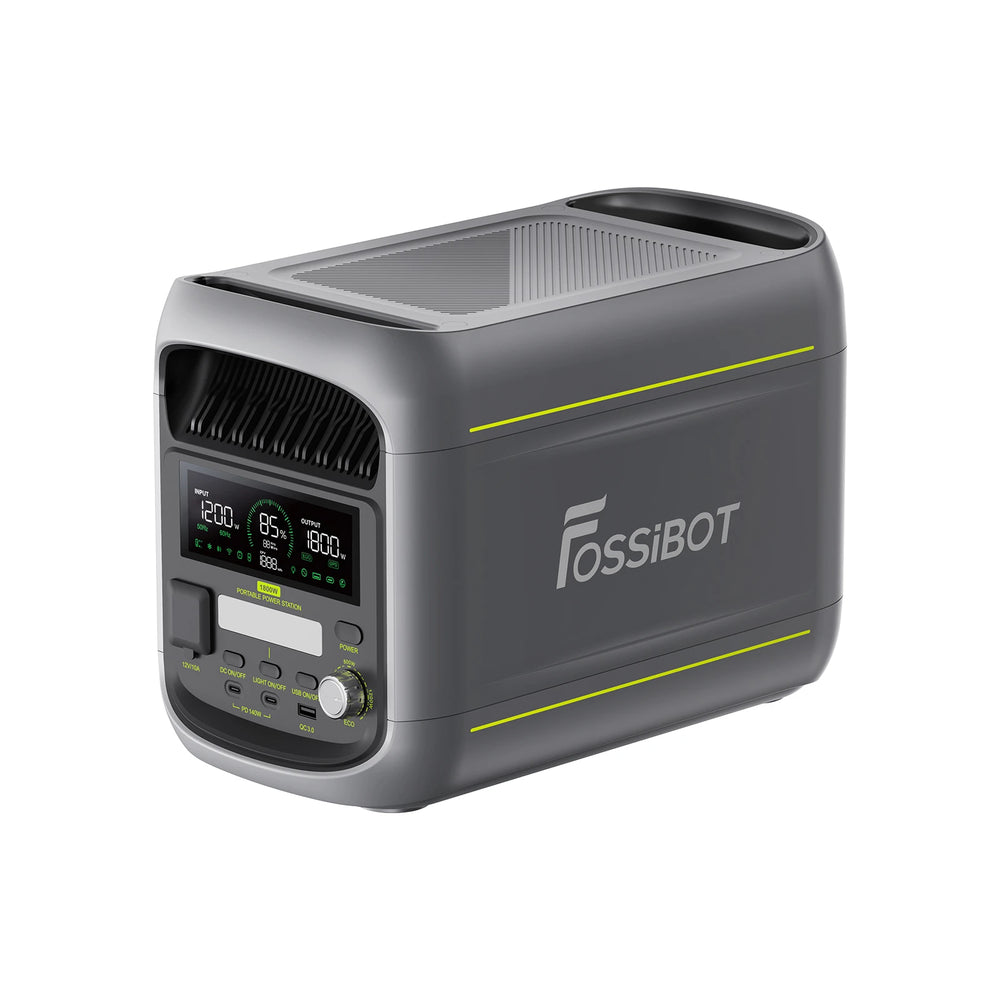
For example, the FOSSiBOT F1800 offers 1,024Wh of capacity and up to 1,800W of continuous AC output, while the FOSSiBOT F2400 provides 2,048Wh and up to 2,400W of continuous output.
The important thing is to match capacity and output to your actual needs. A smaller unit may be enough for phones, lights and cameras, while a larger capacity becomes more useful when you add a laptop, fan, cooler or multiple users.
3. Add Solar Charging
Solar panels can help recharge a power station during the day, reducing how much stored energy you need to carry.
The basic setup is:
Solar Panel → Portable Power Station → Your Devices
Solar output depends on weather, sunlight, shading, panel orientation and season. A panel will not necessarily produce its rated output throughout the day, and UK winter conditions can significantly reduce generation.
For longer off‑grid trips, however, solar can provide a useful way to replenish your battery without an EHU.
4. Charge from Your Vehicle
If you are driving to your campsite, your vehicle can provide another way to recharge compatible power equipment.
This is particularly useful for short trips: charge while travelling and use the stored energy once you arrive. Charging speed depends on the vehicle, charging equipment and power station, so check compatibility beforehand.
5. Use a Leisure Battery
Leisure batteries are commonly used in caravans and motorhomes.
For example, a 12V 100Ah battery has a nominal capacity of approximately:
12V × 100Ah = 1,200Wh
However, the usable energy depends on the battery chemistry, depth of discharge and system configuration.
A leisure battery can be charged from a vehicle, charger or solar system depending on the setup. It can be a practical option for caravans and motorhomes, while a portable power station may be more convenient for campers who want an all‑in‑one solution.

Power Options at a Glance
| Option | Best For | Main Advantage | Main Limitation |
| Power bank | Phones and small USB devices | Lightweight | Limited capacity |
| Portable power station | Multiple devices and appliances | High capacity and flexible outputs | Heavier |
| Solar panel | Longer off‑grid trips | Recharges during the day | Weather dependent |
| Vehicle charging | Short trips | Convenient while travelling | Requires a vehicle |
| Leisure battery | Caravans and motorhomes | Good for vehicle setups | Less portable |
How Long Can You Camp Without an EHU?
There is no single answer because it depends on your daily electricity consumption.
For example, if your equipment uses around 300Wh per day, a 1,024Wh battery could theoretically provide several days of basic power before recharging. In real use, available energy will be lower because of conversion losses and other variables.
If your daily consumption rises to 600–700Wh because you are running a cooler, laptop and fan, the same battery will naturally last much less time.
As a general guide:
- Around 1,000Wh: suitable for many moderate weekend setups
- Around 2,000Wh: more comfortable for longer trips or heavier use
- Larger capacity and/or solar: useful for extended off‑grid camping
The best way to size your system is to start with your actual daily energy use.
How to Make Your Power Last Longer
A few simple habits can significantly reduce unnecessary battery consumption.
Charge Before You Leave
Fully charge phones, cameras, tablets and other rechargeable devices before your trip.
Use USB‑C When Possible
If a device supports USB‑C charging, using it directly can avoid unnecessary AC conversion.
Choose LED Lighting
LED camping lights generally consume relatively little power and are well suited to off‑grid use.
Limit High‑Power Appliances
Electric kettles, heaters, toasters and similar appliances can consume a lot of energy in a short time. If you are camping without EHU, consider whether you really need to run them from your battery.
Recharge During the Day
If you have solar, use daylight hours to replenish your stored energy and avoid unnecessary daytime consumption.
What Is the Best Power Setup for EHU‑Free Camping?
The best setup depends on your camping style.
| Camping Situation | Practical Power Setup |
| Overnight + phone charging | Power bank |
| Weekend + phones, lights and camera | Power bank or compact power station |
| Weekend + laptop, fan, cooler and multiple devices | Around 1,000Wh |
| Longer trip + multiple users | Around 2,000Wh |
| Extended off‑grid camping | Larger power station and/or solar |
| High‑power appliances | Higher‑output power station with sufficient capacity |
For many campers, a portable power station combined with solar charging offers a good balance. The battery provides stored electricity when needed, while solar can help replenish it during the day.
Camping Without EHU: A Simple Approach
You don't need a complicated electrical system for a normal camping trip.
1. List your devices.
Write down everything you expect to charge or run.
2. Estimate your daily energy use.
Consider how long you will actually use each device.
3. Choose enough battery capacity.
Leave some headroom rather than sizing the battery exactly to your estimate.
4. Plan how you will recharge.
For short trips, vehicle charging may be enough. For longer trips, consider solar.
5. Prioritise essential devices.
If your battery gets low, save power for communication, lighting and navigation.

FAQ
1. How do you get electricity when camping without EHU?
You can use power banks, portable power stations, leisure batteries, vehicle charging or solar panels. The right option depends on your devices, trip length and how much electricity you need.
2. Can you camp without an electric hook‑up in the UK?
Yes. Many UK campsites offer non‑electric pitches. You simply need your own power solution if you want to use electrical devices during your stay.
3. How much power do I need for a weekend camping trip?
For basic phone, lighting and camera use, a power bank or smaller battery may be enough. If you also want to run a laptop, fan, cooler and several devices, around 1,000Wh or more may be more suitable.
4. Can a portable power station replace an electric hook‑up?
For many camping setups, yes. A suitable power station can provide stored electricity without connecting to campsite mains power. However, its capacity is finite, so longer trips or high‑power appliances may require additional battery capacity or solar charging.
5. How can I recharge a portable power station while camping without EHU?
Depending on the model, you may be able to recharge it from solar panels, a vehicle or another compatible power source. Solar is particularly useful for longer off‑grid trips because it can replenish the battery during daylight.
Conclusion
Camping without an electric hook‑up does not mean going without power. It simply means taking responsibility for where your electricity comes from.
For a simple overnight trip, a power bank may be enough. For a weekend with multiple devices, a power station around 1,000Wh can provide more flexibility. For longer trips or heavier use, around 2,000Wh or a combination of battery storage and solar can give you greater freedom.
Start with your actual camping habits rather than choosing the biggest battery available. Estimate your daily energy use, decide how long you need to stay powered, and choose a system with enough capacity and a practical way to recharge.
With the right setup, an EHU‑free pitch can be comfortable, flexible and genuinely off‑grid.


