
Table of Contents
- Introduction
- How Do You Know What a Portable Power Station Can Run?
- What Can a Portable Power Station Run?
- How Long Can a Portable Power Station Run a Fridge?
- Can It Run a TV, Wi-Fi & Other Home Essentials?
- What Can You Run While Camping?
- Can a Portable Power Station Run an RV?
- Can a Portable Power Station Run an RV Air Conditioner?
- Can It Run a Kettle, Microwave or Coffee Machine?
- What About Power Tools?
- How to Calculate Your Own Runtime
- Which Portable Power Station Size Is Right for You?
- FAQ
- Conclusion
Introduction
Wondering what a portable power station can actually run and how long it can keep your devices powered?
The answer depends on more than battery capacity. Whether you're planning a camping trip, preparing for a power cut, travelling in an RV, or looking for backup power for everyday appliances, you need to consider battery capacity, continuous output and peak power.
Once you understand these three specifications, you can work out whether a power station can run your fridge, TV, kettle, microwave or RV air conditioner—and approximately how long it can run them.
This guide uses common appliances and real-world scenarios to help you choose the right capacity for your needs.

How Do You Know What a Portable Power Station Can Run?
There are three numbers to check before choosing a power station.
Battery Capacity: Wh
Watt-hours (Wh) indicate how much energy the battery stores.
Generally, more Wh means more available energy and longer runtime.
· Around 1,000Wh: camping, electronics and lighter backup
· Around 2,000Wh: longer backup and multiple devices
· 3,000Wh+: extended backup, RVs and higher energy demands
But battery capacity doesn't tell you whether the power station can actually run a particular appliance.
Continuous Output: W
Continuous output tells you how much power the inverter can deliver continuously.
If an appliance requires 2,500W but the power station provides only 1,800W continuous output, it can't run that appliance—even if the battery has plenty of energy.
Peak Output: W
Some appliances briefly draw more power when starting. Refrigerators, air conditioners, pumps and power tools are common examples.
Peak output provides additional headroom for these short surges.
In simple terms:
Wh = How long it can run
Continuous W = What it can run
Peak W = Startup headroom
What Can a Portable Power Station Run?
The table below gives approximate examples using typical power consumption and an estimated 85% usable efficiency.
|
Device |
Typical Power |
~1,000Wh |
2,048Wh |
3,840Wh |
|
Smartphone |
~15Wh/charge |
~55 charges |
~115 charges |
~215 charges |
|
Laptop |
60W |
~14h |
~29h |
~54h |
|
Wi-Fi router |
15W |
~57h |
~116h |
~218h |
|
LED lights |
10W |
~85h |
~174h |
~326h |
|
Fan |
50W |
~17h |
~35h |
~65h |
|
TV |
100W |
~8.5h |
~17h |
~33h |
|
Fridge* |
100W avg. |
~8.5h |
~17h |
~33h |
|
RV AC* |
1,200W avg. |
— |
~1.4h |
~2.7h |
*Actual consumption varies. Refrigerators and air conditioners cycle on and off, so real-world runtime can differ significantly.
For high-power appliances such as kettles and microwaves, output power must also be checked. A larger battery cannot compensate for insufficient inverter output.
How Long Can a Portable Power Station Run a Fridge?
A refrigerator is one of the most useful appliances to consider for emergency backup.
However, its rated wattage isn't necessarily its average consumption. The compressor switches on and off, meaning actual energy use depends on the fridge, temperature and how often the compressor runs.
For a simple example, assuming an average 100W load:
· 1,000Wh: around 8.5 hours
· 2,048Wh: around 17 hours
· 3,840Wh: around 33 hours
These figures are based on continuous 100W consumption.
Can a Portable Power Station Run a Refrigerator?
Yes, potentially.
Check both:
1. The fridge's running power
2. Its startup/surge requirement
A higher peak output can help handle the compressor's startup demand.
If you're only backing up the fridge, around 1,000Wh may be sufficient for shorter outages.
If you also want to power a TV, Wi-Fi router and lights, around 2,000Wh gives you a much larger energy reserve.
Can It Run a TV, Wi-Fi & Other Home Essentials?
For a power cut, you may not need to power your entire home. Instead, focus on essential devices.
For example:
|
Device |
Example Load |
|
Refrigerator |
100W avg.* |
|
Wi-Fi router |
15W |
|
LED lights |
15W |
|
TV |
100W |
That's a combined load of approximately 230W.
At this load:
· 1,000Wh: ~3.7 hours
· 2,048Wh: ~7.6 hours
· 3,840Wh: ~14.2 hours
Add a 60W laptop and your runtime will decrease accordingly.
This is why a 2,000Wh-class power station can be a useful middle ground for home emergency backup.
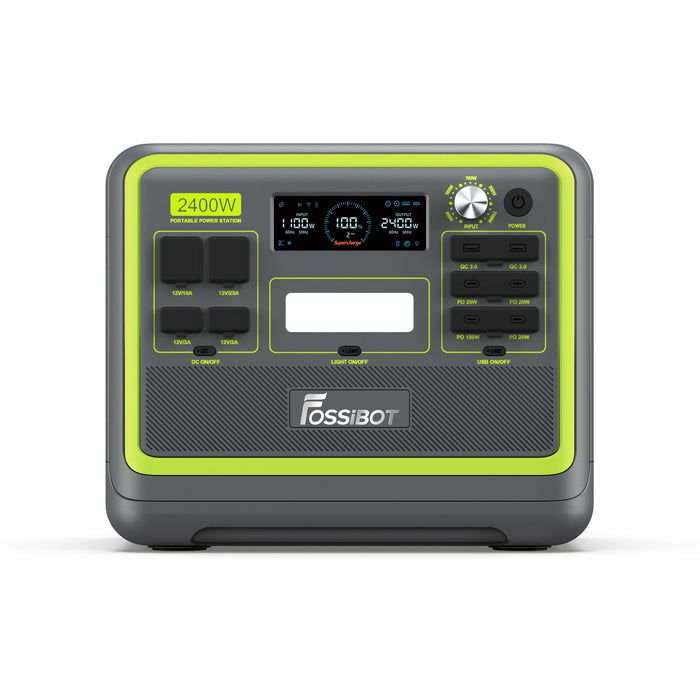
For example, the FOSSiBOT F2400 offers 2,048Wh capacity, 2,400W continuous output and 4,800W peak power.
The product itself isn't the important part here—the key is matching your total load and desired backup time to the available capacity.
What Can You Run While Camping?
Camping usually involves a combination of low- and medium-power devices:
· Phones
· Cameras
· Laptops
· LED lights
· Fans
· Portable fridges
· Small appliances
Weekend Camping
If you're mainly charging electronics, running lights and using a small fan, around 1,000Wh can be enough for many weekend setups.
You don't necessarily need a huge battery if your total daily consumption is relatively low.
Longer Off-Grid Camping
For several days off-grid, requirements can increase quickly.
A portable fridge running continuously, multiple devices, lighting and occasional appliances can make 2,000Wh or more a more practical choice.
The important question isn't just:
“How much power does each device use?”
It's:
“How much energy will all my devices use over the entire trip?”
Can a Portable Power Station Run an RV?
RV users have much wider power requirements.
Lower-Power Devices
A ~1,000Wh power station can be useful for:
· Phones
· Tablets
· Laptops
· Lights
· Cameras
· Small fans
Larger RV Appliances
For:
· Fridge
· TV
· Coffee machine
· Microwave
· Hair dryer
you'll need to check both output and capacity.
A 2,000Wh-class power station can provide a good balance for many RV setups.
The FOSSiBOT F2400, for example, provides 2,400W continuous output and 4,800W peak power, alongside its 2,048Wh battery.
But if you're planning to run an RV air conditioner, the calculation changes.
Can a Portable Power Station Run an RV Air Conditioner?
An RV air conditioner is one of the most demanding appliances you may want to run from a portable power station.
Before choosing one, check:
· Running wattage
· Startup wattage
· Continuous output
· Peak output
· Desired runtime
Let's assume an RV AC uses an average of 1,200W.
2,048Wh Battery
2,048 × 0.85 ÷ 1,200 ≈ 1.45 hours
3,840Wh Battery
3,840 × 0.85 ÷ 1,200 ≈ 2.72 hours
These are estimates, not guaranteed runtimes. The AC compressor cycles on and off, and actual consumption varies by model and conditions.
For higher-demand RV use, a 3,000Wh+ power station provides a much larger energy reserve.
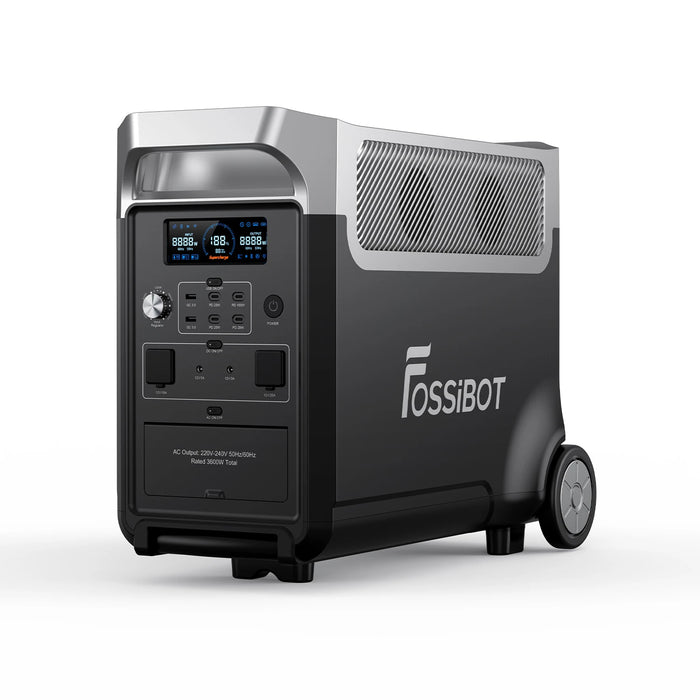
For example, the FOSSiBOT F3600 Pro has 3,840Wh capacity, 3,600W continuous output and 7,200W peak power.
Always compare the power station specifications with your specific RV air conditioner's requirements.
Can It Run a Kettle, Microwave or Coffee Machine?
These appliances highlight why Wh isn't everything.
|
Appliance |
Typical Power* |
|
Coffee machine |
1,000–1,500W |
|
Microwave |
1,000–1,500W input |
|
Toaster |
800–1,500W |
|
Kettle |
2,000–3,000W |
|
Hair dryer |
1,500–2,200W |
*Check your appliance's actual rating.
Suppose your kettle requires 2,500W.
A power station with:
· 1,800W continuous output → No
· 2,400W continuous output → No
· 3,600W continuous output → Yes, assuming other requirements are met
Battery capacity determines how much energy you have, but continuous output determines whether the appliance can run at all.
Also remember that high-power appliances are often used for short periods.
A 2,500W kettle running for five minutes uses approximately:
2,500 × 5 ÷ 60 ≈ 208Wh
So you don't need 2,500Wh of battery capacity to boil a kettle once. You need enough output power to operate it and enough battery capacity for repeated use.
What About Power Tools?
Power tools can have high startup loads, making peak output important.
Common examples include:
· Drills
· Grinders
· Circular saws
· Battery chargers
· Work lights
For smaller tools and occasional use, around 1,000Wh may be sufficient.
For several tools or longer outdoor jobs, 2,000Wh or 3,000Wh+ provides more energy in reserve.
Always check the tool's rated power and starting requirements before choosing a power station.
How to Calculate Your Own Runtime
Once you've confirmed that the power station has enough output, you can estimate runtime with:
Estimated Runtime = Battery Capacity × 0.85 ÷ Appliance Power
For example:
2,048Wh + 100W fridge
→ 2,048 × 0.85 ÷ 100
→ ~17.4 hours
2,048Wh + 500W appliance
→ 2,048 × 0.85 ÷ 500
→ ~3.5 hours
3,840Wh + 1,200W RV AC
→ 3,840 × 0.85 ÷ 1,200
→ ~2.7 hours
These are estimates. Actual runtime depends on inverter efficiency, appliance behaviour, temperature and other factors.
For multiple devices, simply add their power consumption together before calculating.
Which Portable Power Station Size Is Right for You?
|
Your Main Need |
Suggested Capacity |
|
Phones, laptops & small electronics |
~1,000Wh |
|
Weekend camping |
~1,000Wh |
|
Basic emergency backup |
~1,000–2,000Wh |
|
Fridge + TV + Wi-Fi |
~2,000Wh |
|
Longer camping/RV trips |
~2,000Wh |
|
Multiple household appliances |
2,000Wh+ |
|
Extended power cuts |
3,000Wh+ |
|
High-demand RV equipment |
3,000Wh+ |
|
RV air conditioning |
Often 3,000Wh+* |
|
Extended off-grid use |
3,000Wh+ |
*Actual requirements depend on the appliance's running and startup power.
FAQ
Can a 1,000Wh power station run a fridge?
Yes, potentially. Check its running and startup power, then consider what other devices you need to power at the same time.
How long will a 2,000Wh power station run a fridge?
At a constant 100W load, approximately 17 hours using an 85% efficiency assumption. A real refrigerator may run longer because its compressor cycles on and off.
Can a portable power station run a kettle?
It depends mainly on the kettle's wattage and the power station's continuous output. A 2,500W kettle requires sufficient continuous output regardless of battery capacity.
Can a portable power station run an RV air conditioner?
Some high-output models can. Check both the AC's running and startup power, then make sure the battery is large enough for your desired runtime.
Is 1,000Wh enough for camping?
For many weekend camping setups, yes. If you need to run a fridge, several appliances or stay off-grid for several days, 2,000Wh or more may be better.
Is 2,000Wh enough for a power cut?
It can be suitable for essential devices such as a fridge, Wi-Fi, lights and TV. Your actual runtime depends on their combined consumption.
Conclusion
Choosing a portable power station is easier when you start with what you actually want to run.
For phones, laptops, lights and basic camping, around 1,000Wh may be enough.
For a fridge, TV, Wi-Fi and multiple everyday devices, around 2,000Wh provides a larger energy reserve.
For extended backup, demanding RV equipment or air conditioning, 3,000Wh+ can provide considerably more capacity.
Just remember:
Wh tells you how long. Continuous W tells you what you can run. Peak W helps with startup surges.
Check your appliances' actual power requirements, estimate your combined load and desired runtime, and you'll have a much clearer idea of which portable power station is right for you.


