
Table of Contents
- FOSSiBOT F1800 at a Glance
- Design and Portability: How Practical Is the F1800?
- What Can the F1800 Really Run?
- How Long Can the F1800 Run Your Devices?
- How Fast Can the F1800 Recharge?
- Can the F1800 Work as a UPS During a UK Power Cut?
- How Quiet Is the F1800?
- Smart Control with the FOSSiBOT App
- EVE LiFePO4 Battery: Built for Long-Term Use
- ECO Mode: Making Better Use of Available Power
- F1800 for Camping, Caravan and Off-Grid Use
- What We Like About the F1800
- Is the FOSSiBOT F1800 Right for You?
- Final Verdict
- FAQ
Introduction
A portable power station can be useful for much more than camping. In the UK, it can provide backup power during an unexpected outage, keep essential electronics running, or supply electricity when you're away from a mains connection.
But choosing one isn't just about battery capacity. You also need to consider how much power it can deliver, how long it can run your devices, how quickly it can recharge, and how practical it is to use.
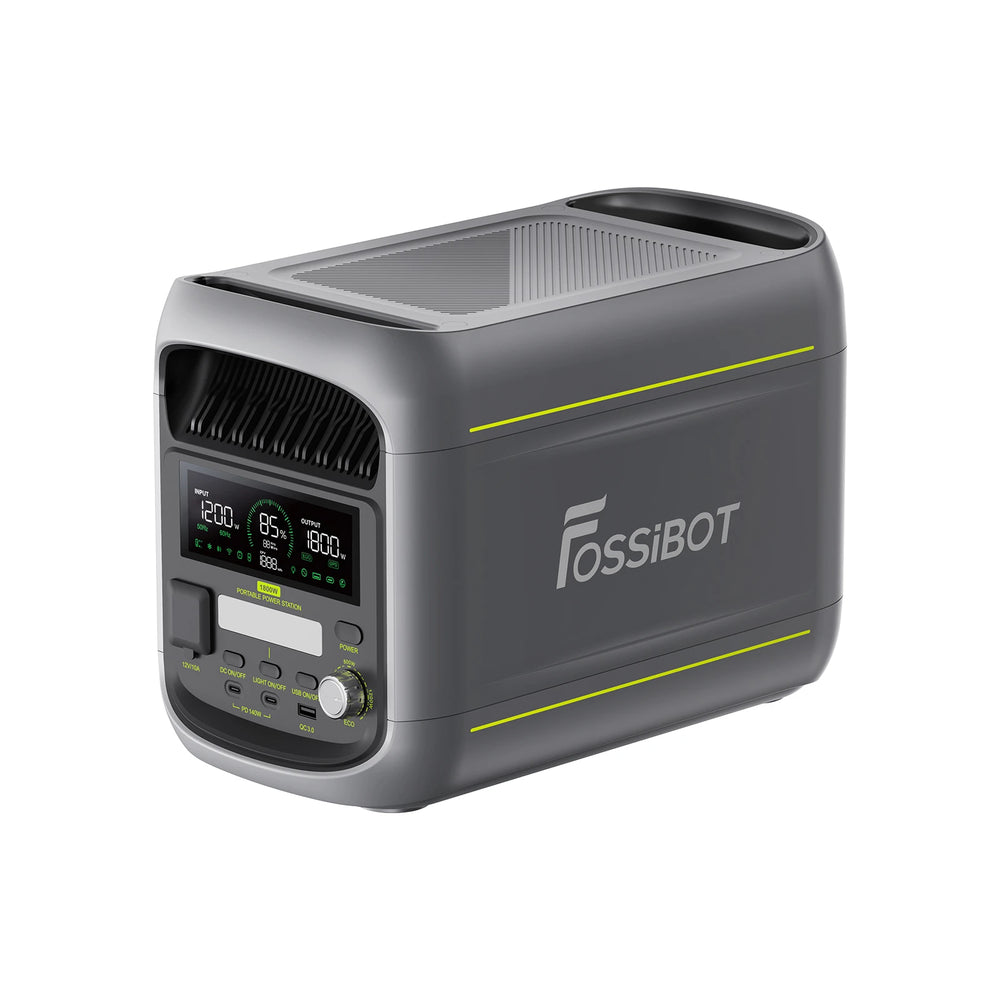
The FOSSiBOT F1800 combines a 1,024Wh battery with 1,800W of continuous AC output and up to 3,600W of surge power. It also features fast charging, solar input, UPS functionality and app control. So, what can it actually do in everyday situations? Here's a closer look.

FOSSiBOT F1800 at a Glance
|
Specification |
FOSSiBOT F1800 |
|
Battery Capacity |
1,024Wh |
|
AC Output |
1,800W |
|
Surge Output |
3,600W |
|
Battery Type |
EVE® LiFePO4 |
|
Battery Cycles |
Up to 4,000 |
|
AC Charging |
Up to 1,200W |
|
Solar Input |
Up to 500W |
|
UPS Switching |
<10ms |
|
Operating Noise |
~30dB |
|
App Control |
Yes |
|
Warranty |
2+3 years |
The combination of 1,024Wh capacity and 1,800W output puts the F1800 in a useful middle range. It offers substantially more capability than a compact power bank while remaining easier to move and store than many larger-capacity home backup systems.
Design and Portability: How Practical Is the F1800?
A 1,024Wh power station needs to be practical to move. After all, you may use it in different rooms at home, take it camping, or load it into a car for an outdoor trip.
The F1800 is designed to be 14% smaller and 11% lighter than comparable models, making it easier to carry, store and move between locations.
That matters in everyday use. A power station isn't very useful if it's difficult to get where you need it. For home backup, you might want it near your router or other essential electronics during a power cut. For camping or caravan trips, portability becomes even more important.
The F1800 is therefore designed around a balance between battery capacity and manageable size rather than simply maximising capacity.
What Can the F1800 Really Run?
This is where the F1800's 1,800W output becomes important.
Two numbers help explain what a power station can do:
Wh (watt-hours) tells you how much energy the battery stores.
W (watts) tells you how much power it can deliver at a given time.
With 1,800W of continuous AC output, the F1800 can power a broad range of everyday electronics, appliances and equipment, provided their power requirements are within its output limits.
For example:
|
Device |
Typical Power* |
F1800 Use |
|
Laptop |
~60W |
✓ |
|
TV |
~100W |
✓ |
|
Wi-Fi router |
~10W |
✓ |
|
Refrigerator |
~100–200W while running |
✓ |
|
Microwave |
~1,000W |
✓ |
|
Electric kettle |
~1,500W |
✓ |
|
Power tools |
Varies |
Depends on the tool |
*Actual power consumption varies by device and model.
**Refrigerators cycle on and off and may have a higher startup demand.
The important point is that 1,800W doesn't mean every appliance will consume 1,800W. A lower-power device uses less energy, allowing the battery to last longer.
For appliances with motors or compressors, such as refrigerators and some power tools, startup power should also be considered. The F1800 can provide up to 3,600W of surge power, giving it additional headroom for devices that require a higher burst of power when starting.

How Long Can the F1800 Run Your Devices?
Battery capacity gives you a starting point for estimating runtime, but real-world results are affected by conversion losses and the way a device operates.
A simple estimate is:
Estimated runtime ≈ Battery capacity (Wh) × 0.85 ÷ Load (W)
For the F1800, that gives approximately:
100W load: 1,024 × 0.85 ÷ 100 ≈ 8.7 hours
300W load: 1,024 × 0.85 ÷ 300 ≈ 2.9 hours
500W load: 1,024 × 0.85 ÷ 500 ≈ 1.7 hours
These are theoretical estimates rather than guaranteed runtimes. Actual performance depends on the connected device, power conversion efficiency, operating cycles and other conditions.
For a more detailed breakdown of 1,024Wh runtime calculations, see our guide to how long a 1,024Wh power station can run.
How Fast Can the F1800 Recharge?
Fast charging can be just as important as battery capacity, particularly when you're using a power station for backup power.
With AC input, the F1800 can reach 80% charge in around 45 minutes and a full charge in approximately 1 hour.
This means you don't necessarily need to leave it charging overnight every time you use it. If the battery has been partially depleted, it can be replenished relatively quickly before another trip or during preparations for a potential outage.
The F1800 also supports up to 500W of solar input, offering an alternative charging method when you're camping or using the power station away from mains electricity.
Under suitable conditions, a full solar recharge can take approximately 2 hours. Actual solar charging time depends on factors such as sunlight intensity, panel output, temperature and other conditions.
Can the F1800 Work as a UPS During a UK Power Cut?
For UK households, one of the F1800's most useful features is its <10ms UPS switching.
When connected devices are powered through UPS mode, the F1800 can switch to battery power in less than 10 milliseconds when mains electricity is interrupted.
This can help keep essential devices such as:
Wi-Fi routers
laptops
computers
CPAP machines
other essential electronics
running through a power interruption.
A portable power station shouldn't be treated as a replacement for a whole-home backup system. Instead, the F1800 provides a way to select the devices that matter most and keep them powered when the mains supply is unavailable.
For more practical advice, see our guide to staying safe during a UK power cut.
How Quiet Is the F1800?
Power stations are often used indoors or overnight, so noise can make a difference.
The F1800 operates at around 30dB, helping keep its operating noise relatively unobtrusive in quieter environments.
That can be useful when you're working from home, sleeping, camping, or using backup power indoors. While the actual noise level can vary depending on operating conditions, the F1800 is designed to avoid becoming a distracting source of background noise.
Smart Control with the FOSSiBOT App
The F1800 can also be managed through the FOSSiBOT App, giving you access to information and controls without relying entirely on the power station's physical interface.
You can monitor battery status, check output and manage energy usage in real time.
For home backup, this means you can quickly check the remaining battery level. When camping or travelling, it provides another convenient way to keep track of how much power you're using.
EVE LiFePO4 Battery: Built for Long-Term Use
The F1800 uses EVE® LiFePO4 battery cells, with a rated lifespan of up to 4,000 charge cycles.
LiFePO4 chemistry is commonly used in portable power stations where long-term, repeated charging is important. For users who expect to use a power station regularly rather than only during emergencies, battery cycle life can be an important consideration.
The F1800 comes with a 2-year standard warranty, plus a 3-year extended warranty, providing additional coverage for long-term ownership.
ECO Mode: Making Better Use of Available Power
The F1800 includes an ECO Mode designed to manage energy use more efficiently.
It prioritises battery and solar power, supports automatic bypass switching and includes low-battery protection. These functions are designed to help avoid unnecessary battery use while maintaining stable power output.
For people who keep a power station ready for regular use, features like these can be useful because efficiency isn't only about how large the battery is. It's also about how the available energy is managed.

F1800 for Camping, Caravan and Off-Grid Use
The F1800 isn't limited to home backup.
For camping, it can provide power for everyday electronics, lighting, refrigeration and other equipment without relying on an electric hook-up.
For caravan or campervan trips, its 1,024Wh capacity can provide a useful reserve for devices throughout the day. The ability to recharge through solar also makes it suitable for trips where access to mains electricity is limited.
Its 1,800W output gives it another advantage for outdoor use: you're not restricted to small USB-powered devices. Depending on their power requirements, you can also run higher-wattage appliances and equipment.
If you're planning a trip without an electric hook-up, see our guide to camping without electric hook-up in the UK.
What We Like About the F1800
The F1800 combines several features that make it suitable for both home and outdoor use:
1,024Wh capacity for extended use
1,800W continuous output for a wide range of appliances
3,600W surge power for higher startup demands
Fast AC charging, reaching 80% in around 45 minutes
Up to 500W solar input for off-grid charging
<10ms UPS switching for selected essential devices
EVE LiFePO4 cells rated for up to 4,000 cycles
~30dB operating noise
App control for real-time monitoring
A more compact and lighter design than comparable models
Things to Consider
The F1800 may be more power than you need if your main requirement is simply charging phones, tablets or other USB devices. In that case, a smaller power station can be easier to carry.
It's also important to remember that the actual runtime of any power station depends on what you're powering. High-wattage appliances will use the battery much faster than lower-power electronics.
Is the FOSSiBOT F1800 Right for You?
The F1800 is designed for users who need more than a compact power bank but don't necessarily want a much larger home backup system.
It can make sense for UK home backup, where the UPS function can help keep selected essential devices running during a power cut. It's also suited to camping, caravans and off-grid use, particularly when you need to power several devices or higher-wattage equipment.
Its combination of 1,024Wh capacity, 1,800W output, 3,600W surge power, fast charging and solar input gives it flexibility across different situations.
If your needs are limited to lightweight USB charging, however, a smaller and more compact power station may be a better fit.
Final Verdict
The FOSSiBOT F1800 takes a practical approach to portable power. Instead of focusing on battery capacity alone, it combines a 1,024Wh battery with 1,800W output, 3,600W surge power, fast recharging, solar input, UPS functionality and smart monitoring.
For UK users, that combination makes it relevant to several different situations—from keeping essential electronics running during a power cut to powering appliances and equipment on a camping or caravan trip.
Ultimately, the right power station depends on what you need to run and how long you need to run it. For users looking for a versatile 1,024Wh portable power station with 1,800W output, the F1800 offers a balance of capacity, power and everyday usability.
FAQ
How long will the FOSSiBOT F1800 run?
Runtime depends on the power consumption of the connected device. As a simple estimate, multiply the 1,024Wh capacity by 0.85 and divide by the device's wattage.
What can a 1,800W power station run?
An 1,800W power station can run many everyday electronics, appliances and tools, provided their continuous and startup power requirements are within its limits.
Can the F1800 run a fridge?
Yes. The F1800 can power many refrigerators, but actual runtime depends on the fridge's running and startup power as well as its operating cycle.
Can the F1800 be used as a UPS?
Yes. The F1800 supports UPS functionality with switching in less than 10ms, helping selected essential devices stay powered during a mains interruption.
How quickly can the F1800 charge?
With AC input, the F1800 can reach 80% in around 45 minutes and a full charge in approximately 1 hour.
Can you charge the F1800 with solar panels?
Yes. The F1800 supports up to 500W of solar input. Under suitable conditions, a full solar recharge can take approximately 2 hours.


