
Introduction
Open your energy bill and you'll see two numbers: the unit rate and the standing charge. The unit rate is simple—you pay for what you use. But that daily standing charge? That appears whether you use a single watt or not. So what exactly is it? Why do you pay it even when you're on holiday? And is there anything you can actually do about it?
This article explains what standing charges are, why they exist, and whether a portable power station can help you reduce what you pay overall—without needing to switch suppliers or move house.

What Is a Standing Charge?
Think of It as Your "Connection Fee"
A standing charge is a fixed daily fee you pay just to be connected to the gas and electricity network. Whether you use one kilowatt-hour or a hundred, the charge stays the same.
Ofgem defines it as the part of your bill that covers the cost of maintaining the wires, pipes, and cables that deliver energy to your home. It's not optional—as long as you're connected to the grid, you pay it.
The amount you pay depends on three things: your supplier, how you pay (Direct Debit is usually cheaper), and where you live in England, Scotland, or Wales.
What Does Your Standing Charge Actually Pay For?
Your daily standing charge covers several behind-the-scenes costs:
· Network maintenance: Keeping the cables, pipes, and substations that deliver energy to your home in working order
· Supplier operations: Call centres, billing systems, meter reading, and customer support
· Government social and environmental programmes: Support for vulnerable households and renewable energy initiatives
· Meter management: Maintaining your gas and electricity meters, including data collection
These are fixed costs that energy companies face regardless of how much energy you use. The standing charge spreads these costs across all connected households.
Why Does It Vary by Region and Payment Method?
Standing charges aren't the same for everyone. Ofgem notes that the amount depends on:
· How many people live in your region
· How much energy your region uses on average
· The cost of building and improving the energy network in your area
· Your payment method (Direct Debit is typically cheaper than standard credit or prepayment)
Some regions pay as little as 52p per day, while others pay over 64p per day. Either way, it adds up to over £300 a year—before you've used any energy at all.
Why Do Standing Charges Exist?
The Logic Behind the Fee
The reasoning is straightforward: energy companies maintain a massive infrastructure network—cables, pipes, substations, call centres—whether you use a lot of electricity or a little. These costs are fixed. By recovering them through a daily standing charge, suppliers can keep the unit rate (what you pay per kWh) lower for everyone.
That's the theory.
The Problem—Low Users Get Hit Hardest
In practice, standing charges are deeply unfair to low-energy users.
A household that carefully saves energy—turning off lights, using less heating, running fewer appliances—pays the same daily fee as a household running a tumble dryer and electric heater all day.
Citizens Advice and Energy UK have both raised concerns about this. Energy UK noted that standing charges have risen significantly in recent years, disproportionately affecting low-income households and those who use less energy.
What Happened to the "Zero Standing Charge" Proposal?
In February 2025, Ofgem proposed introducing a zero standing charge tariff—a plan that would require all energy suppliers to offer an option with no daily fee, but a higher unit rate.
The idea was to give consumers more choice in how they pay for their energy.
But the proposal never became reality. Ofgem found that shifting all costs onto the unit rate would leave most consumers with minimal benefit, while some households—including low-income families—would face much larger bills. It also risked weakening the price cap's role as a universal safety net.
The takeaway: standing charges aren't going anywhere.
What Does the Standing Charge Mean for Your Household?
Your Bill Has Two Parts—and You Can Only Control One
Your energy bill is made up of:
1. Unit rate: What you pay per kilowatt-hour (kWh) of electricity you use—the more you use, the more you pay
2. Standing charge: A fixed daily fee just for staying connected—whether you use power or not
The Ofgem price cap limits both the unit rate and the standing charge. But it doesn't cap your total bill. The more energy you use, the higher your total bill.
Here's the Part You Can't Control
Turning off lights, switching to LED bulbs, and reducing heating? Those reduce your unit-rate costs, but they don't touch the standing charge.
Switching suppliers? Everyone charges a standing fee—just at slightly different rates.
Going on holiday? You're still paying 57p a day while you're away.
The standing charge is the one part of your bill that's completely out of your control—until you start generating or storing your own power.

Can a Portable Power Station Actually Help?
Since you can't control the standing charge, the only practical option is to reduce how much you take from the grid.
Think of it this way: you're paying a daily connection fee. The less power you actually buy through that connection, the better value that fee becomes.
Home Battery Storage UK Without Solar – Charge Off-Peak, Use During Peak Times
Electricity isn't the same price 24/7. Many smart tariffs offer overnight rates as low as 7-10p/kWh—well below the standard daytime rate.
Here's how it works:
1. Charge your FOSSiBOT power station overnight at the cheap rate
2. Use that stored power during the day for your phone, laptop, lights, and small appliances
3. Pull less (or nothing) from the grid during peak hours
The effect: your effective unit rate drops from 26p+ per kWh to around 10p. You still pay the standing charge, but each kilowatt-hour you use costs significantly less.
This is what "home battery storage UK without solar" means in practice—storing cheap electricity and using it when grid power is expensive. The difference? A fixed home battery system costs £4,500–£6,500 to install. A FOSSiBOT portable power station does the same job for a fraction of the cost—and you can take it with you.
Plug and Play Solar Battery Storage – Charge for Free on Sunny Days
If you have outdoor space—a garden, balcony, or even a sunny windowsill—pair your FOSSiBOT with portable solar panels for zero-cost charging.
Every kilowatt-hour you generate yourself is one you don't buy from the grid. And the standing charge? It suddenly feels like much better value when you're buying less power through it.
The UK government is fast-tracking legislation to get plug-in batteries "in shops within months." But you don't need to wait. FOSSiBOT power stations are already plug-and-play—connect solar panels, and you're generating your own power.
Stay Powered When the Grid Goes Down
The grid isn't always reliable. Extreme weather, equipment failures, and high demand can all cause blackouts.
A fully charged portable power station keeps the essentials running—your fridge, router, phone, and even medical equipment—when the street goes dark.
It's not just about saving money. It's about staying connected and protected when the grid can't deliver.
Why FOSSiBOT?
Not all portable power stations are built for daily charging and discharging. Here's why FOSSiBOT is different:
Built to Last – LiFePO₄ Battery
The FOSSiBOT range uses LiFePO₄ (lithium iron phosphate) batteries. Unlike standard lithium-ion batteries that degrade after 500–800 cycles, LiFePO₄ delivers over 4,000 charge cycles while retaining 80%+ capacity. That's nearly 10 years of daily use.
Safe for Sensitive Electronics – Pure Sine Wave Inverter
FOSSiBOT features a pure sine wave inverter, delivering clean, stable power that's identical to what you get from the grid. That means it's safe for sensitive electronics—laptops, medical devices, CPAP machines—and can even handle high-draw appliances like kettles and refrigerators.
Fast Charging – Ready When You Are
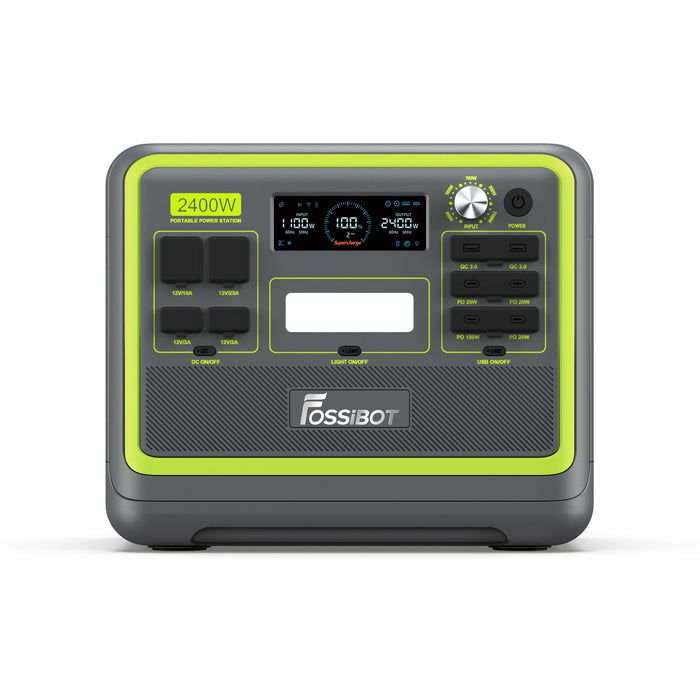
FOSSiBOT power stations recharge quickly—so you're not left waiting. The F2400, for example, can be fully charged from 0 to 100% in just 1.5 hours with a maximum input of 1600W (AC + solar combined). That means less time plugged in and more time powered up.
Which One Should You Choose?
The right model depends on your daily usage:
|
Usage Level |
Typical Devices |
Recommended Model |
|
Light |
Phone, laptop, lights, Wi-Fi router |
F1200 (1024Wh) |
|
Medium |
Fridge, TV, monitor, garden office basics |
F2400 (2048Wh) |
|
Heavy |
Multiple appliances, power tools, whole-room power |
F3600 Pro (3600W continuous output) |
Need a more detailed buying guide? Check out our related article: How to Choose the Best Portable Power Station for Vanlife UK – Off-Grid Camping Guide
The Bottom Line
· A standing charge is a daily "connection fee" you pay just to be connected to the grid
· It covers network maintenance, supplier operations, and government programmes
· It's not going away—the "zero standing charge" proposal was never implemented
· You can't control it, but you can control how much power you buy through the grid
· A portable power station—charged off-peak or with solar—lets you use less grid power, making that daily fee much better value
· With LiFePO₄ battery technology and pure sine wave inverters, FOSSiBOT power stations are built for years of daily use—not just emergencies
You can't control the standing charge. But your energy bill? That's a different story.
FAQ
Q1: What is a standing charge on an energy bill?
A standing charge is a fixed daily fee you pay just to be connected to the gas and electricity network. You pay it regardless of how much energy you use—even if you use none at all.
Q2: What does my standing charge pay for?
It covers network maintenance (wires, pipes, cables), supplier operations (call centres, billing), and government social and environmental programmes.
Q3: Why do standing charges vary by region?
Standing charges depend on your supplier, your payment method, and where you live. Regional differences are based on population density, average energy use, and network costs in that area.
Q4: Why didn't the "zero standing charge" tariff happen?
Ofgem proposed it in early 2025, but it was never fully implemented. The agency found that shifting all costs onto the unit rate could leave many households—especially low-income families—worse off.
Q5: Can a portable power station help me avoid the standing charge?
No. As long as you're connected to the grid, you pay the standing charge. But a portable power station can dramatically reduce how much power you actually buy from the grid—by charging off-peak or with solar—which lowers your total bill.
Q6: How long will a FOSSiBOT power station last?
FOSSiBOT uses LiFePO₄ batteries that deliver 4,000+ charge cycles with 80%+ capacity retention—nearly 10 years of daily use.


